
What Happens to the Other 97% of Your Website Traffic?
Every day, businesses spend thousands of dollars attracting visitors to their websites.
They invest in Google Ads, SEO, social media campaigns, email marketing, influencer partnerships, content creation, and countless other strategies designed to bring people through their digital front door.
Then they celebrate when conversions come in.
A form submission. A phone call. A booked demo. A purchase.
But there’s a question most businesses never stop to ask:
What happened to everyone else?
Because while companies obsess over conversion rates, lead counts, and sales reports, the overwhelming majority of website visitors leave without taking any measurable action.
No form submission. No purchase. No phone call. No conversation.
Just gone.
And for many businesses, that represents the largest untapped revenue opportunity sitting right in front of them.
The Website Traffic Illusion
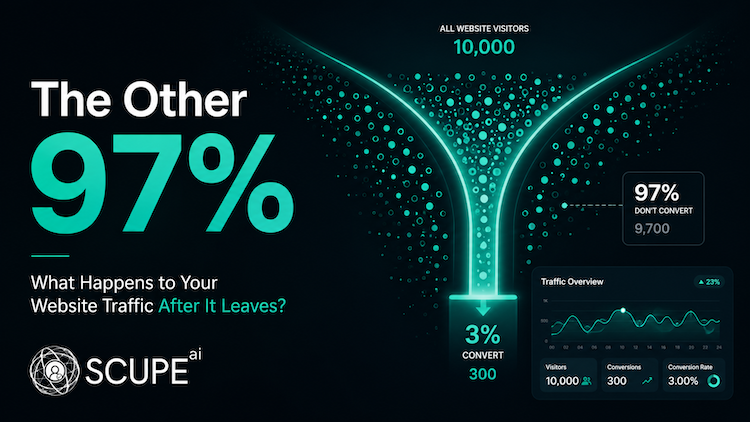
Imagine your business receives 10,000 website visitors each month.
At a 3% conversion rate, that’s 300 conversions.
Most marketing teams would consider that a success.
After all, 300 conversions sounds impressive.
But let’s look at the numbers differently.
Out of those 10,000 visitors:
- 300 converted
- 9,700 did not
Yet most companies spend nearly all of their time analyzing the 300.
They review form submissions. They optimize sales processes. They improve onboarding. They nurture leads.
Meanwhile, 9,700 visitors disappear without further consideration.
The irony?
Many of those visitors were genuinely interested.
They researched your services. Viewed product pages. Compared pricing. Read testimonials. Visited key pages.
Then left.
Not because they weren’t qualified.
Not because they weren’t interested.
But because timing wasn’t right.
They got distracted. Needed additional information. Wanted to compare competitors. Had internal approvals pending. Or simply weren’t ready to make a decision in that moment.
The assumption that every non-converting visitor is unqualified is one of the most expensive mistakes businesses make.
Why More Traffic Isn’t Always the Answer
When growth slows, the default response is usually predictable:
“Let’s drive more traffic.”
Increase ad spend. Publish more content. Launch another campaign. Expand targeting. Generate more visitors.
But acquiring more traffic without maximizing existing traffic is like pouring water into a bucket with a hole in the bottom.
The leak remains.
The costs increase.
The efficiency declines.
Customer acquisition costs continue to rise across nearly every industry.
Clicks cost more. Competition is increasing. Attention spans are shrinking. Every visitor is becoming more expensive to acquire.
Which means businesses can no longer afford to view non-converting traffic as disposable.
The economics simply don’t work.
The companies winning today aren’t necessarily generating the most traffic.
They’re extracting more value from the traffic they already have.
Every Visitor Represents Intent
Not all website traffic is created equal.
Someone who lands on your homepage and immediately leaves may have little interest.
But what about visitors who:
- Spend several minutes on your website?
- Visit multiple pages?
- Review your services?
- Browse product collections?
- View pricing information?
- Return multiple times?
Those behaviors signal intent.
In traditional sales environments, businesses would never ignore this level of engagement.
If someone walked into a retail store, spent twenty minutes browsing products, asked questions, examined pricing, and then left, most sales teams would consider them a prospect.
Yet online, this happens thousands of times every month and businesses simply accept the loss.
The digital world has conditioned companies to believe that if a visitor doesn’t convert immediately, the opportunity is gone.
In reality, many buying journeys require multiple touchpoints.
The challenge is maintaining visibility after visitors leave.
The Hidden Cost of Anonymous Traffic
The largest problem facing businesses today isn’t necessarily traffic generation.
It’s anonymity.
A visitor arrives.
They interact with your website.
They demonstrate interest.
Then they disappear.
The business has no way to identify them. No way to understand who they were. No way to follow up. No way to continue the conversation.
As a result, significant marketing investments produce incomplete outcomes.
Businesses know traffic arrived. They know visitors engaged. But they have limited visibility into who those visitors actually were. This is where website visitor identification can provide greater insight into who is interacting with your website.
This creates a massive gap between marketing performance and revenue potential.
The Shift Toward Traffic Monetization
Historically, website analytics focused on aggregate behavior.
Page views. Sessions. Bounce rates. Traffic sources.
While these metrics provide useful insights, they rarely answer the most important business question:
Who are the people behind the traffic?
Modern businesses are beginning to shift from traffic generation toward traffic monetization.
Instead of asking:
“How can we get more visitors?”
They’re asking:
“How can we create more value from the visitors we already have?”
This shift changes everything.
Marketing becomes more efficient. Advertising becomes more profitable. Customer acquisition costs become easier to manage. Revenue opportunities expand without requiring additional traffic investments.
Why First-Party Data Matters More Than Ever
The digital marketing landscape is changing rapidly.
Privacy regulations continue to evolve. Third-party tracking methods are becoming less reliable. Consumer behavior is changing.
Businesses increasingly need better ways to understand and engage their audiences.
First-party data has emerged as one of the most valuable assets a company can own.
Unlike rented audiences on social media platforms, first-party data creates direct opportunities for businesses to build stronger customer relationships.
Companies that invest in understanding their existing website traffic are positioning themselves for long-term growth.
Those that rely exclusively on generating new traffic may find acquisition costs becoming increasingly difficult to sustain.
The Future Belongs to Businesses That Capture More Value
The next generation of marketing leaders will think differently about website traffic.
They won’t view visitors as temporary events.
They’ll view them as business assets.
Every visitor represents an opportunity. Every visit represents intent. Every interaction represents potential future revenue.
The companies that thrive won’t necessarily be the ones with the biggest advertising budgets.
They’ll be the ones that understand how to maximize the value of every visitor they earn.
Because at the end of the day, success isn’t simply about generating traffic.
It’s about creating outcomes from the traffic you already have.
And when you start asking what happened to the other 97% of your website visitors, you may discover that your greatest growth opportunity has been sitting right in front of you all along.
Turn More of Your Existing Website Traffic Into Revenue
If your business is already investing in SEO, paid advertising, social media, content marketing, or email campaigns, you’re already paying to attract website visitors.
The question is no longer how to generate more traffic.
The question is how much value you’re capturing from the traffic you already have.
Scupe helps businesses identify website visitors, uncover valuable customer insights, and create more opportunities from the traffic they have already worked hard to earn.
Instead of letting interested visitors disappear forever, businesses can gain greater visibility into their website audience and build more effective follow-up and remarketing strategies.
Whether you’re an e-commerce brand, home service company, agency, professional service provider, or growing SaaS business, understanding who is visiting your website can help unlock new revenue opportunities hiding in plain sight.
Start your free Scupe trial today and see how many potential customers are already visiting your website.
Try Scupe free for 14 days or 200 visitor profiles, whichever comes first. No credit card required.
Frequently Asked Questions
What percentage of website visitors typically convert?
Conversion rates vary by industry, traffic source, and offer, but many websites convert between 1% and 5% of visitors. That means the majority of website traffic leaves without converting during that visit.
Why do visitors leave websites without converting?
Visitors may be researching, comparing options, waiting for approval, evaluating competitors, or simply not ready to buy. Lack of immediate conversion does not necessarily indicate lack of interest.
Is driving more traffic always the best growth strategy?
Not necessarily. Increasing traffic can generate growth, but improving the value extracted from existing traffic often produces a higher return on marketing investment.
How can businesses maximize existing website traffic?
Businesses can improve conversion paths, strengthen follow-up processes, optimize customer journeys, leverage first-party data, and implement visitor identification strategies to better understand and engage website audiences.


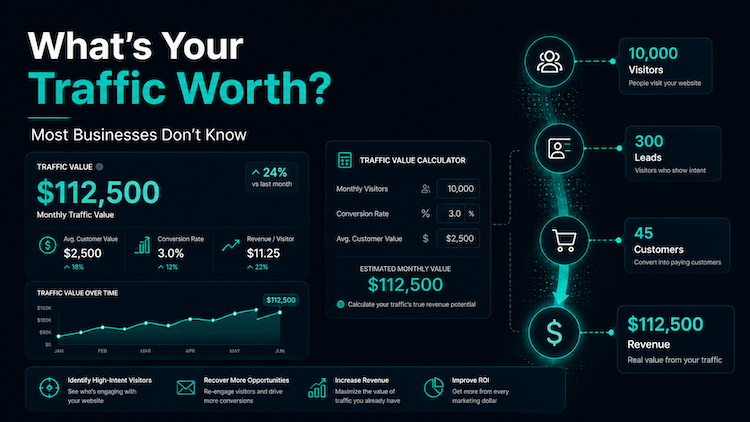
Make every visitor count.
more of your existing traffic into customers.